Selected Exhiibitions
2026 That Future Thing! Oriel Tŷ Merion, Dyffryn Ardudwy, Wales
2026 Altered States, Canfas Gallery, Cardigan, Wales
2025 Unforeseen Patterns, Oriel Brondanw, Llanfrothen, Wales
2023 A State of Mind, Mid Wales Arts, Caersws, Wales
2023 A State of Affairs, Storiel, Bangor, Wales
2022 New Work, Canfas Gallery, Cadigan
2021 Paradoxes, MOMA, Machynlleth, Wales
2020 The Strange Edge of Reality Part 2, Oriel Ynys Môn, Llangefni, Wales
2016 The Strange Edge of Reality Part 1, Tenby Museum and Art Gallery, Tenby, Wales
2016 The Late November Gallery, Haverfordwest, Wales
2014 El Foco Rojo, Oaxaca de Juarez, México
2014 La Jicara Librespacio Cultural, Oaxaca de Juarez, México
2013 Galeria Azomalli, Oaxaca de Juarez, México
2013 La Olla Restaurante / Galería, Oaxaca de Juarez, México
2013 ISMOS, Cuidad de México, México
Recent Group Exhibitions
2022 Gallery Gwyn, Aberaeron, Wales
2022 PEA, Mid Wales Arts, Caersws, Wales
2022 Summer Show, Plas Glyn y Weddw, Wales
2021 Annwn, Ty Pawb, Wrexham, Wales
2021 Summer Show, Attic Gallery, Swansea, Wales
Bio
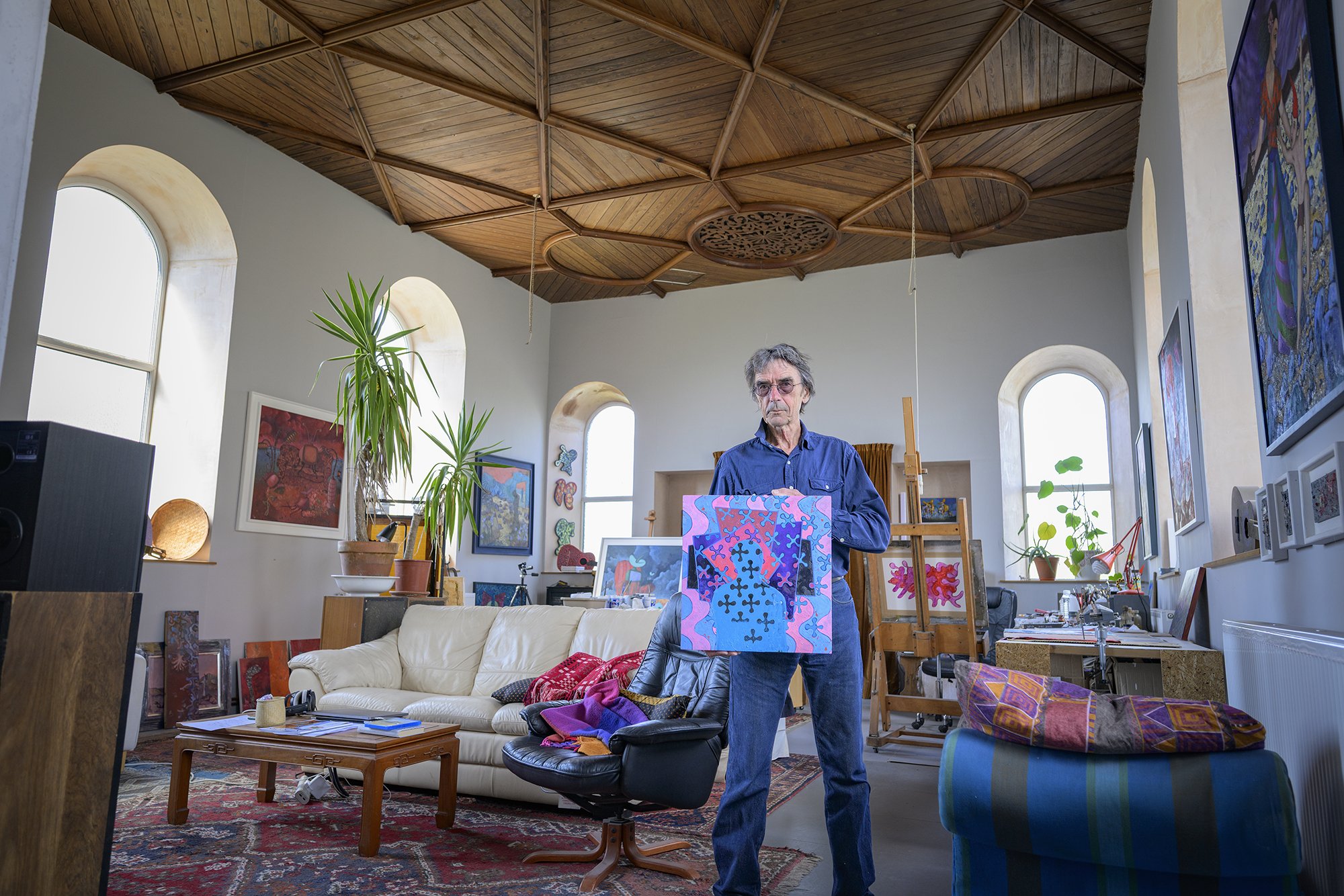
Born in 1954 in Birmingham, Warwickshire, United Kingdom. Lives and works in North Wales. The son of renowned Welsh artists Gwilym Prichard and Claudia Williams. He studied at Liverpool School of Art. In 1976, he graduated with a 1st-class Honours degree and was awarded the prestigious John Moores Scholarship. After continuing his studies at St Martins School of Art, London, Pritchard travelled widely, living and working in New York, Berlin, Paris and Mexico. He has supplemented his creative practice with private teaching, construction, and other unusual occupations. In addition to painting, he works with sound, video, and sculpture. He has exhibited widely both in his homeland and abroad. Leaving Mexico permanently in 2015, he has now retuned to his Celtic roots in the wilds of North Wales
Some Notes on the Work of Ceri Pritchard
Neal Brown
Ceri Pritchard’s paintings are fascinating, not least for their extremity. They are resolute in their classically fantastical, surrealist conviction, and this can be a lonely position in the context of contemporary art. It is not a complete isolation though, as there is a distinguished continuity of surrealist practice in Wales where Pritchard lives and works 1. The artist has such a sense of this surrealist purpose, and such a diligent work ethic, that it makes him a total example of painterly conviction.
By being resident in a number of different countries, Pritchard has experienced different influences. He lived in (and was once married in) Mexico and the psychotropic ethnobotany and magic-based religion that is traditional there have an important relationship with his painting. Shamanic psilocybin use in Mexico is often combined with a kind of strange, unlikely magico-catholicism, and not so dissimilarly magico-religious practices involving mushrooms take place in Wales. Although he is now personally abstinent from any psycho-tropic chemical use, Pritchard has experience of it. This qualifies a description of his work as sometimes being as frighteningly anxious, and having as ugly a mood, as a bad drugs experience, but always with a magically transformative intent.
He previously worked in a psychedelic-abstract style, but this transformed significantly (but not completely) in 2008 when he commenced his surrealist works and their narratives of psychological interiority. These paintings are characterised by Surrealism’s traditional interests: dreams, the uncanny, fantasy, hypnosis, the psycho-sexual, and the mind alterations of psychotropic drugs. In conversation, Pritchard resists detailed analysis of the subject matter he depicts, but even a glance reveals an interest in order and disorder, power and disempowerment. Many disparities of power can be seen depicted in his works, often involving persons of disproportionate size – a theme that might reference parents and children, gender relations, or even possibly the militarised relationships that exist between nation-states.
Pritchard was, and still is, an accomplished sonic artist. He became a practitioner during the late 1960’s and early 1970’s, using tape loops and home-built synthesisers to make hypnotic, experimental music. As both his painting and music involve surrealist and psychedelic themes, these put him in a relationship with the music and rich visual heritage – particularly the graphic work – of progressive rock, which was often engrossed with both 2. Examples of Pritchard’s psychedelic music and video collage work can be seen online, and this material should rightly be considered a significant part of his practice. It is perhaps – and notwithstanding the achievement of his painting – the most complete and perfect expression of his art 3.
NOTES
1.Important (even if only occasional) surrealist work in a Welsh context includes that by Dylan Thomas, Graham Sutherland, Merlyn Evans, Ceri Richards, Cedric Morris, Nina Hamnett, Augustus John, George Melly, and John Piper. More recent surrealist work includes that by Neil Coombs et al in the group exhibition Surrealism in Wales shown at the Last Gallery, Llangadog, in 2012. Adrian Dannatt gives an excellent description of this subject in Surrealism in Wales, (Neil Coombs and Adrian Dannatt, Dark Windows Press, Rhos-on-Sea, 2012).
2. Welsh psychedelia includes John Cale, the band Man, and Super Furry Animals.